

Chapter One : The Diagnosis

For most of my adult life I have struggled silently with food and my stomach issues.
For a long time I hid it. It was easier that way. Easier than explaining why I wasn’t eating something. Easier than talking about symptoms people don’t really talk about. Easier than admitting that I was sick or in pain when I couldn’t explain why.
Then about 12 years ago, things got significantly worse, and I knew I couldn’t keep pretending everything was okay.
What followed was years of uncomfortable conversations, doctor appointments, specialist referrals, tests, food journals, elimination diets, and desperately searching for answers.
Most of those appointments ended the same way.
“I don’t know.”
My family doctor looked at me and said, “Honestly, I don’t know what to tell you.”
I saw a naturopath hoping maybe a different approach would help.
“I don’t understand what’s happening.”
I saw a dietician.
“This doesn’t make sense.”
Over and over again I heard some version of the same thing.
“We don’t know.”
After enough years of that, you start to wonder if maybe there isn’t an answer. Maybe this is just your life. Maybe you’re the exception that nobody can explain.
So I stopped looking for a while.
Not because I felt better.
Not because the symptoms went away.
But because I was exhausted.
Instead, I focused on learning how to manage it. How to work around it. How to prevent my symptoms from completely controlling my life.
This is also where my wife and I started calling me “allergy kid.”
Was it technically correct? We had no idea.
But when every meal feels a little bit like Russian roulette, sometimes humour becomes survival.
You joke because the alternative is admitting how scared you actually are.
As time went on, things started getting worse again. My symptoms were becoming harder to manage and harder to ignore.
I went back to my family doctor and told her I felt like my life was revolving around my stomach. It was stopping me from living. I was unconsciously not making plans, I was choosing take out over going to restaurants just incase I had a reaction and there were times I had to leave early or had to cancel plans due to not being well.
That’s when she suggested I see an allergy immunologist.
“There is an amazing one in Cambridge,” she said.
I laughed and told her I would travel anywhere if someone could help me.
So I waited.
And waited.
It took almost eight months just to get the appointment call.
Then finally, appointment day arrived.
I was excited.
But I was also terrified to be excited.
After years of dead ends, hope felt dangerous.
At the time we suspected I might have MCAS. My gastroenterologist thought it was possible. My family doctor thought it was possible. Everyone agreed the allergy immunologist would know.
So I walked into that appointment carrying years of questions and trying very hard not to expect answers.
Everything happened so fast.
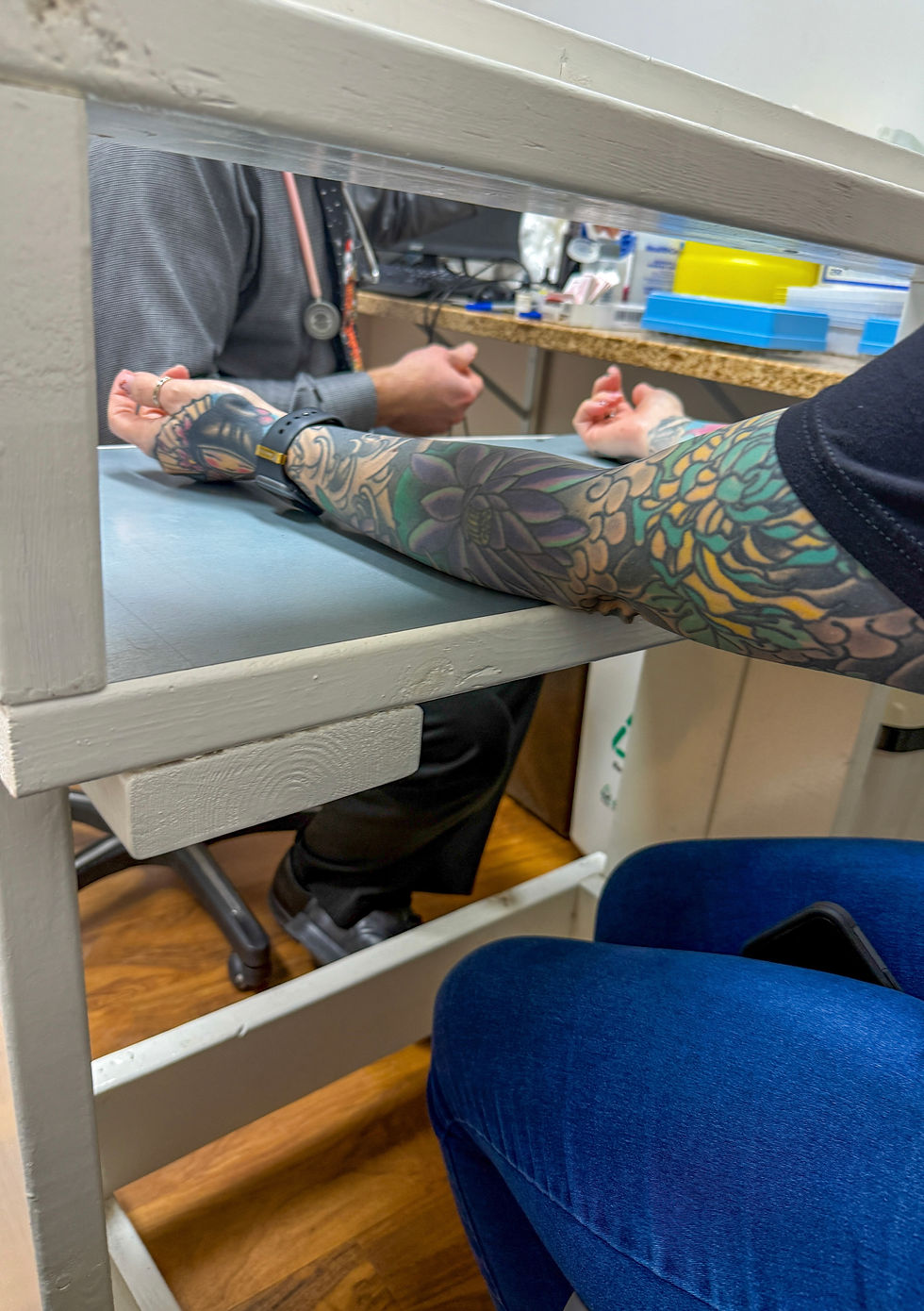
He tested my arms while asking questions about my symptoms. Then we walked into his office.
Before I had really even sat down, he looked at me and said:
“I know what you have.”
My heart immediately dropped into my stomach.
Did he really?
Was that even possible?
He explained that my reactions were too delayed to be histamine-related.
“Histamine reactions happen quickly,” he said.
And honestly, that made sense.
Then he said the words that would change everything.
“You have FPIES.”
Inside my head I was thinking:
What the fuck is FPIES?
Well, FPIES stands for Food Protein-Induced Enterocolitis Syndrome.
It is a non-IgE-mediated food allergy, which means the allergic reaction happens differently than what most people think of when they hear the word allergy.
Instead of hives or anaphylaxis, the reaction happens inside your stomach.
And when I say reaction, I mean violently ill.
The really strange part is that FPIES is mostly seen in infants and young children. Most children outgrow it between the ages of three and five.
This is where I insert the joke that I am, in fact, a child at heart. I will forever love Lego, Disney Pixar movies, and all things a little bit whimsical. So of course, naturally, I ended up with a condition usually found in children.
Unfortunately, adults don’t outgrow FPIES.
When you develop it as an adult, it is considered lifelong.
One of the biggest challenges is that there simply isn’t a lot of information about adult FPIES.
Even my allergy immunologist told me that he is probably one of the most knowledgeable people locally on the topic, and there are still things he doesn’t fully understand.
The last six months have been a lot to process.
Because this diagnosis gave me something I had spent years searching for:
Answers.
Validation.
Proof that I wasn’t imagining it.
Proof that my body wasn’t betraying me for no reason.
But those answers also came with grief.
Because while I finally understood what was happening, I also learned that it wasn’t something I could fix.
For the first time in my life, I had a name for what I was experiencing.
And that name changed everything.
Over the coming weeks and months, I want to share more about what living with adult FPIES actually looks like. The symptoms, the challenges, the fears, the humour, the adjustments, and everything in between.
If you’ve been following along on my health journey, thank you.
And if this is the first time you’re hearing about FPIES, welcome.
I’m still learning too.
As always, thank you for being here. 💕


Hi I hope you get some good news very soon . So you can live happy and healthy